

This report outlines Italtile's remuneration philosophy and policy for non-executive directors, executive directors and prescribed officers. It explains how the policy was implemented during the year under review and provides details of the remuneration paid to non-executive directors, executive directors and prescribed officers.
The report focuses on the fixed and variable elements of executive remuneration, as well as fees paid to NEDs and uses the single-figure disclosure format.
The report is divided into three sections:

The following frameworks have been applied in the preparation of the remuneration report:
| 1 | While the Company has not adopted King V in its entirety yet, the remuneration disclosures are in line with King V. |
The Remuneration Committee is satisfied of the Company's compliance in terms of the remuneration disclosure requirements of King V, the JSE Listings Requirements and the Companies Act.

It is a pleasure to present the Remuneration report of Italtile for the year ended 30 June 2026.
The mandate of the Committee is to exercise oversight of the Group's remuneration practices and policies to ensure they promote the achievement of strategic objectives and encourage individual performance. It focuses on responsible remuneration practices and structures across the Company and strives for fair, competitive and transparent remuneration.
The Committee is committed to:
The main remuneration outcomes in the reporting period were as follows:
Historic shareholder engagement resulted in adjustments to the executive retention scheme structure and targets. No further shareholder engagement was undertaken in the year under review.
At the AGMs held in the past three reporting periods, the Group's shareholders approved the Company's Remuneration policy and the Implementation report, as follows:
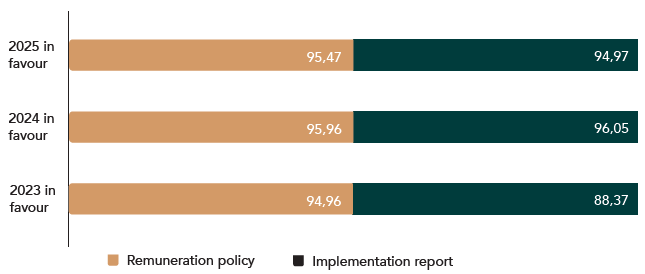
As required by the Companies Act and King V, the following resolutions will be tabled for shareholder voting at the AGM, details of which can be found in the Notice:
Refer to the Notice to AGM.
As delegated by the Board, the Committee assists in setting the Company's Remuneration policy and reviews, recommends and approves the remuneration of executive and NEDs, prescribed officers and senior management (collectively referred to as "the executive team").
A core responsibility of the Remuneration Committee is to ensure that the remuneration philosophy and policy support Italtile as follows:
According to its terms of reference, the Committee's roles and responsibilities are to:
Key focus areas and decisions for the Remuneration Committee to take include:

Fixed remuneration
Annually, undertake a review of executives' guaranteed salaries and approve the framework for increases for all other employees, ensuring fixed remuneration is fair and market-related.
Key performance indicators (KPIs)
Review the approach to KPI setting and KPI targets across the organisation to ensure KPIs remain relevant and actionable for driving business performance and are integrated into periodic financial and performance reviews. The executive team's KPIs are approved annually.
Short-term incentives
Analyse the structure of STIs to strengthen the philosophy of empowerment and sharing, which is premised on the principle that each employee makes the fullest contribution to the business's success and shares proportionally in its financial success. Feedback on the STIs is provided below. The STI structures and awards for the executive team, as well as the framework for all other employees, are approved annually.
Long-term incentives
Review long-term incentives, to ensure the incentives motivate and reward employees while driving the desired performance and accountability. The long-term incentive structures and awards for the executive team, as well as the framework for all other employees, are approved annually.
Responsible and fair pay
Monitor remuneration practices, structures and policies on an ongoing basis to promote fair, reasonable, and equitable compensation for work of equal value, considering the nature of the work, employees' skills and contributions. Identified anomalies are addressed. The requirements of the Companies Amendment Act 16 of 2024 are considered in this process.
Talent management and succession planning
Review the effectiveness of the talent management framework and analyse succession plans.
Non-executive director fees
Consider and recommend approval of NEDs' fees to the Board.
In 2026, the Committee also oversaw the development of an NED policy, including the philosophy, approach and criteria for setting NED fees.
Refer to the Company website at www.italtile.com for the NED policy.
Feedback to the Board and shareholders
The Committee Chairperson reports to the Board after each Committee meeting and attends the AGM to answer shareholders' questions on the Committee's area of responsibility.
For internal and external factors that influenced Committee decisions this year, refer to the Remuneration Implementation report.
The Company's Remuneration policy is presented to shareholders for approval by ordinary resolution at the AGM in accordance with section 30A of the Companies Act. Once approved by shareholders, the Remuneration policy will remain in force for a period of three years from the date of approval and will be submitted for shareholder approval every three years thereafter. Should the Remuneration policy not be approved by ordinary resolution, it will be presented for shareholder approval at the next AGM or at a shareholders' meeting convened for that purpose. The Remuneration policy may be amended during the three-year approval period. However, any material amendment may only be implemented after approval by shareholders by ordinary resolution at a shareholders' meeting convened for that purpose or at an AGM.
The Company's Remuneration report is presented to shareholders annually for approval by ordinary resolution in accordance with section 30B of the Companies Act. Should the Remuneration report not be approved by ordinary resolution at an AGM, the Remuneration Committee will, at the next AGM, provide an explanation of the manner in which shareholders' concerns have been taken into account. In addition, subject to the provisions of section 30B(6) of the Companies Act, the directors who are not involved in the day-to-day management of the business of the Company and who serve on the Remuneration Committee will be required to stand for re-election as members of the Committee at the AGM at which such explanation is presented. Should the Remuneration report in respect of the subsequent financial year also not be approved by ordinary resolution at the next AGM, those directors may continue to serve as directors of the Company, provided they are successfully re-elected to the Board where applicable, but will not be eligible to serve on the Remuneration Committee for a period of two years thereafter. The provisions relating to re-election and Committee eligibility do not apply to members of the Remuneration Committee who have served on the Committee for less than 12 months during the year under review.
The Remuneration Committee is a sub-committee of the Board and meets at least three times per annum. An independent NED chairs the Committee, which comprises five NEDs, the majority of whom are independent.
The current members of the Committee are: Mrs S M du Toit (appointed as Chairperson on 22 May 2026), Mrs L R Langenhoven, Mr G A M Ravazzotti, Mr L Lourens (appointed to the Committee on 3 October 2025) and Mrs L C Prezens (appointed 22 May 2026).
The previous Chairperson, Mrs A M Mathole, resigned on 22 May 2026, and Mr S G Pretorius resigned from the Committee on 3 October 2025.
The Board considers the Committee's composition appropriate in terms of the necessary knowledge, skills and experience of its members. The Committee obtains expert advice to stay up to date on remuneration practices.
The Committee reviews remuneration, Board-leading practices and remuneration trends to assess market competitiveness. The Committee reviews external remuneration benchmark reviews published by PwC and other market information when determining pay levels and structures.
The Italtile Group Company Secretary, Acorim Proprietary Limited, attends all Committee meetings as secretary. The CEO and CFO attend all meetings by invitation to provide input and guidance regarding executive team remuneration.
No attendee may participate in any discussion or decision regarding their own remuneration.
The Committee met five times during the period under review. Attendance at the meetings was as follows:
| Board member | Attendance at meetings |
| S M du Toit (Chairperson – appointed as Chairperson on 22 May 2026) | 5/5 |
| G A M Ravazzotti | 3/5 |
| L R Langenhoven | 5/5 |
| L Lourens2 | 3/3 |
| L C Prezens3 | 1/1 |
| B G Wood5 | 5/5 |
| L Booysen5 | 5/5 |
| A M Mathole4 | 4/4 |
| S G Pretorius1 | 5/5 |
| L A Foxcroft6 | 5/5 |
| 1 | Resigned from the Committee on 3 October 2025 and continued attending by invitation. |
| 2 | Appointed to the Committee on 3 October 2025. |
| 3 | Appointed to the Committee on 22 May 2026. |
| 4 | Resigned from the Committee on 22 May 2026. |
| 5 | By invitation. |
| 6 | By invitation: Lance Foxcroft resigned as director of the Company on 30 June 2026. |
We believe that this Remuneration report provides an accurate overview of the Company's Remuneration policy, its implementation, and, specifically, an in-depth view of executive management remuneration in the past year.
As the applicable framework and environment evolve in the year ahead, we will adapt accordingly to ensure our remuneration practices and disclosures remain compliant and appropriate.
S M du Toit
Remuneration Committee Chairperson

Italtile is committed to maintaining pay levels that reflect an individual's worth to the Group. The Group's philosophy is to treat employees as business partners, developing their sense of ownership and to pay for performance.
Our remuneration philosophy is guided by the principles of equity, fairness, pay for performance and affordability, ensuring alignment between management and shareholder requirements.
Remuneration policies are designed to attract, reward and retain the executive team and employees needed to deliver on the business strategy and key corporate objectives.
Fair, equitable and responsible pay is a core principle of our reward framework. The Company applies equal remuneration for work of equal value and does not allow discriminatory pay practices. Reward decisions are based on merit, taking into account skills, experience, role requirements and market positioning. Clearly defined salary ranges are reviewed annually and applied consistently to promote fairness, transparency and internal equity.
The Remuneration policy governs remuneration for executive directors and prescribed officers, while informing remuneration practices across all employee levels.
The Remuneration policy subscribes to King V recommendations and principles on which it is based, including the following principles:
Italtile has an integrated remuneration and rewards model that includes guaranteed remuneration, STIs and LTIs. The components of total remuneration for permanent employees, prescribed officers and executives are fixed and variable remuneration.
Fixed remuneration comprises a basic salary and benefits, aligned to roles and performance. Variable remuneration comprises STIs and LTIs, aimed at retaining critical employees. Performance is measured against set performance indicators.
All employees share in the Group's profits based on their individual contributions. The Group has a minimum annual cost-to-company target. The annual target is disclosed in the Implementation report.
A Staff Share Scheme for all employees of the Group and its franchisees was approved by shareholders in November 2022. The first awards under this new scheme were made to qualifying employees in March 2023, with subsequent awards on an annual basis. Awards to participants are in the form of units linked to shares held by a trust, and dividends accruing to participants from the date of issue of awards are retained by the trust to offset the future income tax liability of participants on vesting of the awards. Awards vest after three years if the participant remains in the employ of the Group or its franchisees.
The various elements of remuneration are outlined below.
Guaranteed salary is reviewed annually and positioned competitively against peers that are comparable in size, sector and business. Company performance, affordability, individual performance and average industry and sector increases are considered in determining any annual adjustment. Increases are generally inflation-linked and, where affordable, additional budget is allocated for adjusting remuneration levels that are not appropriately aligned to internal pay ranges and/or market rates for a specific role.
Benefits offered to employees include medical aid, provident fund and other employment-related benefits.
Steps that are taken to improve the lives of the most junior employees are as follows:
The Italtile Group administers incentive schemes to encourage and reward the delivery of its strategic priorities in the short, medium, and long-term. The STI focuses on driving profitability in that financial year, while the long-term incentive closely aligns executives' interests with shareholders' over the longer term. It is also a retention mechanism.
Short-term incentives
All Group employees share in the Group's profits. Profit share is directly linked to each business's profitability, as the profit pool is calculated as a percentage of each business unit's profits. Accordingly, no additional performance targets are set for profit share, as allocations are directly tied to business profitability, ensuring clear alignment between performance and pay. This approach applies consistently across the business and reinforces the core principle of partnership.
Executives take part in the Executive Profit Share Scheme. The Executive Profit Pool is 0,25% of Group profit before tax, shared between the CEO and CFO on a shared unit basis:
The Head of Manufacturing will share in the profit of the manufacturing business once appointed. Recruitment for this role is currently underway. The role is expected to be classified as a prescribed officer, given that the incumbent will exercise general executive control and management over a significant portion of the business.
Refer to the Remuneration Implementation report below for the prescribed officer's profit share.
Long-term incentives
In terms of the policy on LTIs, there are two LTI schemes within the Italtile Group, each rewarding performance appropriately and designed to retain and reward key personnel. The LTIs include:
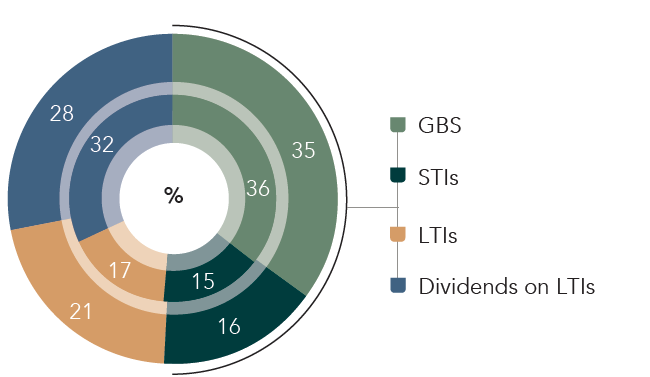
The typical mix between the executive directors' basic salary and short and long-term incentives for FY2025 and FY2026 is shown below:
The Remuneration Committee has the discretion to implement a Malus and Clawback policy, pursuant to which, on the occurrence of a trigger event, and at the instance and direction of the Remuneration Committee, the relevant employer in the Group will be entitled to clawback, a cash amount equal to the whole or any portion of the pre-tax cash proceeds of any cash incentive payment, including any STIs and discretionary payments and 30% of the market value in the case where the incentive payment comprises Italtile shares received by the executive director or prescribed officer.
The Remuneration Committee also has the discretion to require that all incentive payments and awards that have not been settled or vested be adjusted, forfeited, or cancelled upon the occurrence of a trigger event.
A trigger event would include, inter alia, the occurrence of any of the following events or circumstances:
The clawback applies for a period of three years after the cash payment of any short-term incentive and/or discretionary payment has been made to the executive director or prescribed officer in question or, in the case where payment has been made in the form of Italtile shares, three years after the Italtile shares have been transferred to the executive director or prescribed officer in question in terms of the Italtile Retention Scheme.
The Remuneration Committee may exercise responsible and transparent discretion when determining remuneration outcomes.
Discretion may be exercised upward or downward to recognise exceptional performance, align remuneration with actual performance and address exceptional circumstances, including recruitment, retention and termination arrangements.
The Committee applies discretion on the manufacturing side, where it may elect to remunerate technical experts in accordance with market and internal peer benchmarks.
The Committee's exercise of discretion will always be fair and remain within the shareholder-approved remuneration framework. For executives and prescribed officers, the discretionary payments will be fully disclosed in the Remuneration Implementation report, including the nature of the discretion, its financial impact and the factors considered.
Executive and key management's performance is measured in the following categories, with specific performance targets/indicators per category, namely:
The respective weightings for the approved financial targets (HEPS, operating profit and ROSI) and the other non-financial KPIs focused on productivity, transformation, customer service and ESG are set annually.
ESG matters have become more prominent globally. Given the appreciation of material sustainability issues facing our business and the strategic importance of building a sustainable business, we included additional tangible ESG-related KPIs in the year-end scorecards from 2021 to strengthen the link between ESG and remuneration.
The Remuneration Committee believes that the set of KPIs in the executive scorecard, agreed with the CEO, is suitably challenging. The outcome of the CEO's performance evaluation is disclosed in the Implementation report to follow.
Executive directors and prescribed officers have permanent contracts, and the contracts prescribe a three-month notice period. The Company periodically reviews contracts to ensure they remain aligned with governance and legislative requirements.
Refer to the Implementation report for the nonexecutive director fees for 2026.
Shareholders are requested to cast a vote on section 2 of this Remuneration report (Remuneration policy) at the upcoming AGM.

The Group maintained stable revenue, margins and profits across most business units, except Ceramic Industries, whose performance placed significant pressure on overall results. Total system-wide turnover was up 1% at R11,3 billion (2025: R11,3 billion). The Group's trading profit was down 10% at R1,8 billion (2025: R2,1 billion).
While the results failed to meet expectations, the performance was achieved under very difficult trading conditions. Despite the performance, the Group considered the current economic conditions and the need for remuneration to remain competitive and the following salary increases were approved effective 1 July 2026:
The Group has a minimum annual cost-to-company target of R151 722 per employee (2025: R141 990).
In accordance with the Group's commitment to fair pay and being cognisant not to increase the wage gap, the following minimum basic adjustments will be implemented as from 1 July 2026:
| Minimum basic salary | 1/7/2026 – 30/6/2027 | 1/7/2025 – 30/6/2026 | % increase | |
| CTM | R9 000 | R8 450 | 6,5 | |
| TopT | R8 180 | R7 650 | 6,9 | |
| Ceramic Industries | R9 215 | R8 715 | 5,7 | |
The Committee is focused on maintaining competitive remuneration practices across the Group, while balancing the reward and motivation of key personnel with the need to drive accountability for performance. We recognise the need to retain top talent, as it is a prerequisite for meeting growth targets and shareholder expectations.
External factors
Internal factors
In terms of the approved KPIs for the 2026 financial year, financial targets carried a 50% weighting (HEPS, operating profit and ROSI). The other non-financial KPIs focused on productivity, transformation, customer service and ESG and carried a weighting of 50%. This weighting was informed by the need to enhance focus on operational and strategic goals that are crucial to drive financial performance.
The CEO's key performance areas for the year under review were aligned with the KPIs for each scorecard category, as in prior years. Below is an extract of key KPIs and an assessment of performance against the set targets. Note that even though only the CEO's assessment outcome is discussed, the scorecard sets the tone for the other executives, the prescribed officer and the rest of the organisation.
| Performance | Assessment | |||
| Financial (50%) |
|
Under achieved Achieved Achieved |
||
| Strategic (15%) |
|
Under achieved Under achieved Achieved Partially Achieved Achieved |
||
| Operations (10%) |
|
Under achieved Under achieved Under achieved Not achieved |
||
| Human capital (5%) |
|
Partially achieved Under achieved Achieved Not achieved |
||
| B-BBEE (5%) |
|
Superior achieved | ||
| Customer
experience (5%) |
|
Partially achieved | ||
| Cultural
and values (5%) |
|
Achieved | ||
| ESG (5%) |
|
Achieved Achieved Under achieved |
||
Considering the financial performance relative to the year's targets and the overall scorecard performance, the CEO's performance is regarded as 'under achieved'. The CFO and COO's performance for the year was assessed as "achieved."
| * | The following executives held the respective executive roles for the purpose of the performance assessment during the 2026 financial year: |
| CEO: Lance Foxcroft (resigned effective 30 June 2026). | |
| COO: Brandon Wood (appointed as CEO from 1 July 2026). | |
| CFO: Lamar Booysen. |
New strategic objectives and targets have been set for the 2027 financial year and leadership capacity has been strengthened.
The management team continues to display energy, determination and focus in tough trading conditions.
The performance assessment outcome directly impacts decisions on guaranteed pay, STIs and LTIs, as illustrated in the table below.
The Company reviewed industry and JSE benchmarks for executive remuneration during the year, focusing on best practice and comparable companies by market capitalisation (cap) to ensure competitiveness while considering fairness and stakeholder expectations around executive pay.
Changes in directors' interest in the Company's stated capital after financial year-end, as well as participation in share incentive schemes, were announced on SENS on 4 September 2026 and 9 September 2026.
Directors' participation in share incentive schemes
Directors' holdings under the SARS are set out in the table below:
| Executive director | Awards held at 1 July 2025 |
Awarded during the year |
Vested and exercised during the year |
Forfeited during the year |
Awards held at 30 June 2026 |
|
| B G Wood | 1 012 500 | – | – | (1 012 500) | – | |
Note: Directors no longer participate in new awards under the SARS but rather only in the Italtile Retention Scheme.
Directors' and prescribed officers' holdings under the Italtile Retention Scheme are set out in the table below:
| Executive director/prescribed officer | Awards held at 1 July 2025 |
Awarded during the year |
Vested and exercised during the year |
Forfeited during the year |
Awards held at 30 June 2026 |
|
| B G Wood | 2 500 000 | – | (1 000 000) | – | 1 500 000 | |
| L A Foxcroft | 6 000 000 | – | (3 000 000) | – | 3 000 000 | |
| L Booysen | 1 650 000 | – | – | 1 650 000 | ||
| G Maartens | 1 700 000 | – | – | 1 700 000 | ||
Refer to note 6 of the Annual Financial Statements for further details about these schemes.
| All figures in R’000 | Salary | Provident fund and medical aid contributions |
Other | GBS | STIs | LTIs* | Ordinary dividends received |
Special dividends received |
Total dividends received |
Single figure remuneration |
|
| Executive directors | |||||||||||
| L A Foxcroft | 4 520 | 721 | 624 | 5 865 | 2 938 | 4 653 | 2 040 | 5 880 | 7 920 | 21 376 | |
| B G Wood | 3 181 | 525 | 1 059 | 4 765 | 1 959 | 1 861 | 910 | 2 450 | 3 360 | 11 945 | |
| L Booysen | 2 904 | 504 | 289 | 3 697 | 1 632 | 889 | 759 | 1 617 | 2 376 | 8 594 | |
| 2026 | 10 605 | 1 750 | 1 972 | 14 327 | 6 529 | 7 403 | 3 709 | 9 947 | 13 656 | 41 915 | |
| 2025 | 10 779 | 1 769 | 2 126 | 14 674 | 7 183 | 10 810 | 4 974 | 7 917 | 12 891 | 45 558 | |
| Prescribed officer | |||||||||||
| G Maartens | 3 000 | 851 | 435 | 4 286 | 1 364 | 1 013 | 782 | 1 666 | 2 448 | 9 111 | |
| 2026 | 3 000 | 851 | 435 | 4 286 | 1 364 | 1 013 | 782 | 1 666 | 2 448 | 9 111 | |
| 2025 | 3 000 | 851 | 435 | 4 286 | 1 421 | 830 | 833 | 1 326 | 2 159 | 8 696 |
| * | LTIs represent the portion of awards earned during the year, calculated as the number of shares expected to vest multiplied by the 30-day VWAP, divided by the five-year vesting period. Awards vest after five years, subject to the applicable performance and service conditions. |
All remuneration decisions made in the reporting period complied fully with the Remuneration policy, as previously approved by shareholders. There were no known deviations from the policy.
| All figures in R’000 | Board fees | Other | Total 2026 |
Total 2025 |
|||
| Non-executive directors | |||||||
| L R Langenhoven | 2 140 | – | 2 140 | 2 082 | |||
| G A M Ravazzotti | 1 094 | – | 1 094 | 514 | |||
| S M du Toit | 1 064 | 2 | 1 066 | 837 | |||
| S G Pretorius | 896 | – | 896 | 895 | |||
| N P Khoza* | – | – | – | 582 | |||
| L C Prezens | 500 | 4 | 504 | 537 | |||
| J N Potgieter** | 127 | – | 127 | 469 | |||
| A M Mathole | 731 | – | 731 | 735 | |||
| M Matsipa*** | 331 | – | 331 | – | |||
| L Lourens*** | 423 | 3 | 426 | – | |||
| 2026 | 7 306 | 9 | 7 315 | – | |||
| 2025 | 6 629 | 21 | – | 6 651 | |||
| * | Resigned from the Board on 11 June 2025. |
| ** | Resigned from the Board on 13 November 2025. |
| *** | Appointed to the Board on 22 August 2025. |
The following fixed fees (excluding value added tax ("VAT")) were in place for the year under review:
| R’000 | ||
| Basic annual fee | 135 000 | |
| Board meeting fee | 32 500 | |
| Committee fee | 27 500 | |
| Chairperson of the Committee | 33 750 | |
| Strategy session | 39 000 | |
| Chairperson of the Board | 1 625 000 | |
Hourly rate for ad hoc work, not exceeding 144 hours a year: R4 500 per hour.
Executive directors and prescribed officers do not draw any additional remuneration for attending the main Board or Committee meetings.
In accordance with the recently implemented amendments to the South African Companies Act, the required details of our employees' total remuneration for the financial year ended 30 June 2026 are tabled below. These details are disclosed on a total remuneration basis (i.e., including STIs, accrued LTIs at fair value and dividends for permanent employees), which appropriately reflects the implementation of the Remuneration policy. The total relates to South African permanent employees, which are 91% of the total Italtile workforce.
| R’000 | ||
| Total remuneration of the highest-paid employee | 21 367 | |
| Total remuneration of the lowest-paid employee | 106 | |
| Average remuneration of all employees | 351 | |
| Median remuneration of all employees | 210 | |
| Average remuneration of the top 5% highest-paid employees | 2 711 | |
| Average remuneration of the bottom 5% lowest-paid employees | 108 | |
| Pay ratio difference between top 5% and bottom 5% | 25,1:1 | |
Shareholders are requested to cast a vote on section 3 of this Remuneration report at the upcoming AGM.
We value our continued engagement with various stakeholders and endeavour to maintain our relationships with all, in the hope that we will continue to receive their valued input.
The Board approved this Remuneration report of the directors of the Company on 18 September 2026.
Signed on behalf of the Board of Directors
S M du Toit
Remuneration Committee Chairperson

