The Company Secretary is Ms E J Willis and she is neither a director nor a shareholder of Italtile or any of its subsidiaries. On that basis, the Board believes that E J Willis maintains an arm’s-length relationship with the executives, the Board and the individual directors in accordance with paragraph 3.84(j) of the Listings Requirements of the JSE.
The Company Secretary is responsible for administering the proceedings and affairs of the directorate, the Company and, where appropriate, owners of securities in the Company, in accordance with the relevant laws. The Company Secretary is available to assist all directors with advice on their responsibilities, their professional development and any other relevant assistance they may require.
The Nominations Committee has considered the skills and experience of the Company Secretary and the level of competence she has demonstrated as Italtile’s Group Company Secretary since 2009, and in her role as a company secretarial consultant since 2001. The Board, on the recommendation of the Nominations Committee, is satisfied with the level of competence of the Company Secretary as required in terms of paragraph 3.84(i) of the Listings Requirements of the JSE. It requires a decision of the Board as a whole to remove the Company Secretary, should this become necessary.
The Group has adopted a formal Code of Business Ethics and Conduct (“the Code”) which requires all directors and employees to act with honesty and integrity and to maintain the highest ethical standards. The Code deals with compliance with laws and regulations through a system of values and standards.
The Board oversees and ensures that management throughout the Group assumes responsibility for training and mentoring staff on the Group’s values and standards and ensuring compliance.
The Code will be evaluated on a regular basis to ensure it aligns with the Corporate Compliance policy, King III and relevant new legislation.
Italtile is committed to open, honest and regular communication with key stakeholders on financial and non-financial matters. A working partnership between the Group, its suppliers, franchisees, employees and members of the community forms the basis of a mutually beneficial association.
The annual general meeting provides an opportunity to communicate directly with shareholders. The Chairman has the opportunity to present to the shareholders a report on current operations and developments. The meeting also provides a forum for shareholders to question and express their views about the Company’s business. The Chairmen of the Audit and Risk and Remuneration Committees are available at the meetings to answer questions from shareholders.
Notice of the annual general meeting and related documents are mailed to shareholders at least 15 business days before the meeting. Separate resolutions are proposed on each substantially different issue. The notice is contained in the here.
The Group’s executive management team meets with investors after the publication of interim and annual results to present an update on the industry, current operations of the business and its prospects.
All directors of the Company are required to comply with the requirements of the JSE regarding inside information, transactions and disclosure of transactions.
In line with the Financial Markets Act, No 19 of 2012, the Board enforces a restricted period for dealing in Italtile shares, in terms of which any dealings in shares by all directors and senior personnel is disallowed from the time that the reporting period has elapsed to the time that results are released and at any time that such individuals are aware of unpublished price-sensitive information, whether the Company is trading under cautionary announcement as a result of such information or not.
Italtile recognises that managing risk and compliance is an integral part of generating sustainable shareholder value and enhancing stakeholder interests.
The Group has in place an Enterprise Risk Management framework which is based on a combined assurance model comprising: management (divisional and executive directors); external auditors (Ernst & Young Inc.); and Support Centre oversight (including the internal audit function). The structure of this model and its activities are designed to ensure that the Group’s risks are adequately addressed.
The Board, assisted by the Audit and Risk Committee, is responsible for risk, risk tolerance determination, risk management within the Group, performance of risk assessments, the use of acceptable risk methodologies and the monitoring of risk on a continual basis.
The Board ensures there is regular assessment of financial and non-financial risks in the context of the Group’s business environment, with a view to mitigating and/or eliminating risk through the Group’s strategies and processes.
Internal controls are designed to manage rather than eliminate risks of failure to achieve business objectives, and provide reasonable rather than absolute assurance against material misstatement or loss. The internal audit function is a structured review of internal controls based on risk assessment.
The Strategic Imperatives and Material Risks report here discusses the Group’s key risks and issues and the management thereof in detail. In brief they are identified as follows:
The Group has strong relationships with its supply partners, being the largest customer to most of its suppliers. Opportunities to increase capacity by suppliers if required is constantly reviewed, as are alternative sources of supply should any potential disruption be identified. The Group’s acquisition of a strategic stake in Ceramic Industries (Pty) Ltd is evidence of its policy to strengthen key supplier relationships.
Ensuring that the Group remains fashionable and internationally competitive is critical to its continued existence. Staying abreast of fashion trends and evolving consumer behaviour, employing experienced brand managers and capitalising on leading-edge technology are key priorities in this regard.
Reputational risk is managed by ensuring intensive focus on customer service, product quality and competitive pricing. Staff training, motivation and incentivisation are key activities in promoting positive brand awareness. Italtile’s corporate governance, sustainability and environmental policies all contribute to upholding the Group’s brand reputation.
Central to the Group’s success is its business model that promotes partnerships and autonomy (an effective motivator), and has been flexible and adaptable in the past. The Group would be negatively impacted if this philosophy and structure are not adequately preserved. A range of factors mitigate this risk, including: close involvement in the operations of the Group by divisional management and executive directors which serves to reinforce the values of the Group; flat reporting structures which facilitate transparent communication and oversight; and optimal recruitment and training programmes to ensure the business model is entrenched.
The Group has in place a treasury policy, which serves to mitigate against risks, including: under-performing investment returns; inadequate liquidity of investments to meet commitments; and institutional/commercial risk relating to funds into which investments are made.
Foreign currency exposure in imported product is actively managed. All foreign liabilities are matched with forward exchange contracts upon confirmation of import orders.
Trade credit is provided by reputable third-party credit providers, and is available through the retail stores. The Board is confident that an adequate system of internal control is in place, which mitigates areas of significant risk to an acceptable level.
Attracting, developing and retaining human capital is a major focus for the Group. Keen attention is paid to optimal recruitment processes, comprehensive training, and motivation and incentivisation of employees. Ongoing development of leadership and management potential is a critical initiative advanced through high-level training programmes.
All major business processes are computerised and the Group has a formally documented and tested disaster recovery plan in place.
In order to mitigate against the risk of non-compliance with relevant legislation and regulations, the Group regularly engages various professionals and legal advisers. In addition, management attends workshops and training related to legislative and other updates. To an extent, the external audit also provides some assurance related to compliance.
Italtile is committed to good corporate citizenship practices and organisational integrity in the direction, control and stewardship of the Group’s affairs.
The Group recognises the imperative to balance returns for shareholders with the long-term needs of the business, its employees, the broader society and the environment.
The Company is aware of its responsibility to safeguard the interests of all stakeholders and believes that good governance is essential to the Group’s long-term sustainability and functioning. The Group’s objective is to conform stringently to transparency, while operating profitably and remaining accountable to the broader community which it serves.
Shareholders, customers, employees, suppliers, regulators and the communities in which the Group operates are regarded as key stakeholders.
King III places emphasis on the principles of strategy, sustainability and governance and provides for greater integration of those elements. Accordingly, Italtile continues to strive to align the Group’s practices with the recommendations of King III.
Italtile is committed to empowerment in its business and is supportive of transformation in the country. The Group endorses the principles in the Employment Equity Act and aligns its human resources policies accordingly.
As at 30 June 2016
| African | Male | Female | ||||||
| Coloured | Indian | White | African | Coloured | Indian | White | ||
| Skilled to top management | 84 | 18 | 5 | 60 | 20 | 7 | 4 | 30 |
| Semi-skilled and unskilled | 454 | 64 | 8 | 84 | 184 | 32 | 4 | 30 |
| Total | 538 | 82 | 13 | 144 | 204 | 39 | 8 | 60 |
The above statistics apply to South African operations only and do not include the franchised stores. The Group submits its employment equity reports to the Department of Labour on an annual basis and has consistently met relevant targets in recent prior years.
The Group is committed to uplifting the societies in which it operates through following sound employment practices and meeting the real needs of those communities.
Italtile continues to invest in South Africa and neighbouring countries in education, training and skills transfer through the Italtile training academy which has provided tiling, technical and business skills to numerous previously unemployed individuals.
Ad hoc contributions were also made to the following deserving causes:

Furthermore, the Group implemented a community investment programme to establish sports grounds in areas lacking such facilities. This initiative is based on an existing successful venture, the Soweto sports ground, a community-centred facility sustained by various sponsorship efforts, with which the Group has been involved for many years.
In addition, a number of Group and franchised stores make ongoing corporate social investments to various community causes.
The Italtile Foundation Trust (“the Foundation”) is a Broad-Based Black Ownership Scheme, with the objective of carrying on public benefit activities in a non-profit manner and with an altruistic and philanthropic intent, working towards the transformation and upliftment of previously disadvantaged communities. The Foundation accepts and deploys Social Economic Development donations in terms of the BBBEE legislation.
The Foundation’s distributions are towards public benefit activities relating to education, sport and conservation, and current projects include:
Italtile complies with the Occupational Health and Safety Act, No 85 of 1993 and other relevant legislation, regulations and codes of practice for South Africa. The aim of the Group’s Health and Safety policy is to prevent and minimise work-related injuries and health impairments by ensuring that all employees are provided with adequate training and supervision to undertake their roles.
The Group’s Environmental department is instrumental in implementing Italtile’s long-standing environmental consciousness values across the business. Programmes are aimed at measuring, managing and reducing the Group’s impact on the environment and promoting its long-term sustainability. This department operates in conjunction with executive management, with a view to better aligning and integrating the Green agenda into the day-to-day processes and functioning of the business.
The Group’s Green agenda is discussed in greater detail here.
Italtile strives to be the employer of choice in its industry. The Group’s strategy is to recruit and retain the best people from South Africa’s diverse population base, and to ensure they are empowered, accountable for their actions and rewarded accordingly.
The Group’s goal is:
Training and development initiatives are formulated and conducted in-house, ensuring relevance to the Group’s culture, values and strategy.
Training courses are designed for students ranging from beginners to intermediate and advanced levels. Training courses include an induction course for all new employees, as well as focused business, technical, management and corporate governance programmes. Minimum training competencies have been mapped for all job titles to support consistent standards across the Group.
Over the past year training spend and operating costs amounted to R10 million (2015: R10 million). 3 413 (2015: 2 207) staff members completed courses in the review period.
In addition to Group-wide training interventions, Italtile’s Tiling, Plumbing and Laminate Academy continues to raise the benchmark in product knowledge training.
Italtile is committed to satisfying the needs of its customers while delivering acceptable profit growth. The Group endeavours to create wealth for the benefit of all stakeholders.
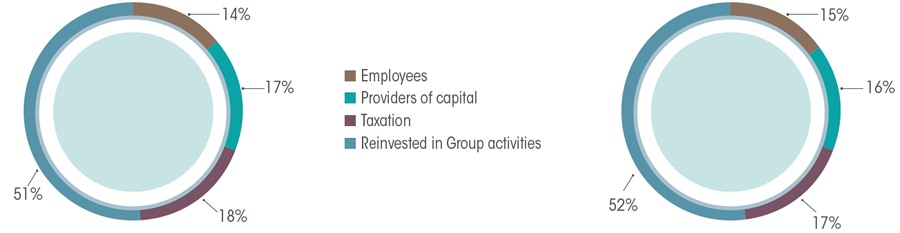
The value added statement is a measurement of the wealth the Group created in its operations by adding value to the cost of raw materials, products and services purchased. The statement shows the total wealth created and how that was distributed.
The statement also takes into account the amounts retained and reinvested in the Group for the replacement of assets and development of future operations.
| 2016 Rm’s |
Group | |||||
| % | 2015 Rm’s |
% | ||||
| Turnover | 3 539 | 3 115 | ||||
| Cost of goods and services | (1 821) | (1 659) | ||||
| 1 718 | 1 456 | |||||
| Income from investments and interest received | 25 | 17 | ||||
| Value added | 1 743 | 1 473 | ||||
| Value distributed and retained | ||||||
| Employees | ||||||
| – Salaries, incentives and benefits | 248 | 14 | 223 | 15 | ||
| Providers of capital | 290 | 17 | 235 | 16 | ||
| – Outside equity holders | 38 | 2 | 31 | 2 | ||
| – Ordinary dividend | 252 | 15 | 204 | 14 | ||
| Taxation | 313 | 18 | 245 | 17 | ||
| Reinvested in Group activities | 892 | 51 | 770 | 52 | ||
| – Depreciation | 79 | 4 | 70 | 5 | ||
| – Retained income | 813 | 47 | 700 | 47 | ||
| 1 743 | 100 | 1 473 | 100 | |||
The total economic impact of an organisation includes indirect impacts. These are usually benefits arising in the course of its business to which a monetary amount is not directly attributable. Italtile does not assess and quantify its indirect economic impacts although the Group does provide indirect economic benefits:
